Dear G20,
I hope this letter finds you influenceable.
I’ve been meaning to write for a while, because it was more than a year ago that something struck me: children, and their rights, seem to be so far down the policy priority list for the average international organisation or government that the world has become habituated to cruelty, disease and death among some of our most vulnerable people.
UNICEF estimates that approximately 13,400 children under five die every day mostly from poverty-related causes. Poverty is avoidable, and so these deaths are avoidable. (Source: Child Mortality – UNICEF DATA)
This is equivalent to seeing around 26 fully-occupied A380s crash every day.
It means millions of families every year suffering deep distress, mourning and pain as they watch their child become sicker and die, without the means to help them.
I understand that, in some quarters, there is a desire to place the responsibility for having children entirely on parents themselves. And, of course, parental responsibility, care and education are all necessary elements of raising children.
But the reality is that no set of parents can take full responsibility for every element of their child’s care and development. It is not possible.
It may be simple to say, “Parents have to find the time, and parents have to provide the care.” But we all live within systems that provide some if not all of the elements of the necessary infrastructure – clean water, health services and education, regulations governing vehicles, employment hours, street lighting, transport, food standards are just some examples. If parents had to manage all these things by themselves, it would simply be too much. It would be impossible.
Everybody’s care and development depend on the communities and societies in which they live. It is our coming together that makes human development possible.
So the throwaway line that “if people cannot afford children, they should not have them” often comes from the mouths of those who seem to not see nor acknowledge the support they themselves receive from their communities and societies. Support that sustains their living standards, facilitates their care, and ensures that, without personal knowledge of medicine or education, their health and learning can still be provided for. Support enough to give them the freedom to express such opinions, for what they are worth.
Nevertheless, even those with these views, like every child, did not choose to be brought into this world.
And so the premise that a child should therefore live or die according to the decisions or responsibility (dare I say it, work history) of their parents alone represents a profound violation of their right to non-discrimination. Their parents may not have had access to adequate sexual and reproductive health care. A mother may herself have been a child, forced into early marriage or experienced sexual violence.
Political willingness to buy into the hubris of ‘can’t afford, don’t have’ is not only an abuse of rights; it also results in an enormous waste of human potential and makes inclusive growth – and the creation of a better world – impossible.
The example that first provoked this line of thinking – and the comparison I want to leave with you – is between two statistics: the daily mortality rate of children under five worldwide and the global mortality rate at the peak of COVID-19 in January 2021.
At the global peak of the pandemic in January 2021, reported COVID-19 deaths reached roughly 14,000 per day. Across 2021 as a whole, approximately 3.3 million reported COVID-19 deaths were recorded, equivalent to around 0.04 per cent of the global population.
By comparison, around 5.1 million children under five died in 2021 – more than 13,400 every day, and almost 2 million more than the COVID number – representing approximately 0.76 per cent of the global under-five population. These are not directly equivalent rates: COVID-19 mortality affected all age groups, while under-five mortality is measured within a much smaller population. Yet, relative to the respective populations, the annual under-five mortality rate in 2021 was 19 times the reported global COVID-19 mortality rate in the same year – a comparison that is so very disturbing.
Moreover, it is important to remember what these figures compare. One is the peak of an extraordinary global health crisis. The other is chronic global health crisis affecting millions of babies and preschoolers, concentrated largely in developing countries – even after that headcount has fallen to its lowest recorded level in recent history (see Figure 1).
Figure 1: Comparing trends in COVID and Under 5 mortality
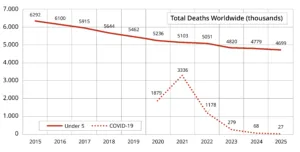
Source: World Health Organization (WHO), COVID-19 Detailed Surveillance Data Dashboard; United Nations, Department of Economic and Social Affairs, Population Division, World Population Prospects.
Note: Annual totals were calculated by summing the values across all countries for each year.
So, where is their debt standstill initiative?
Where is our global response for the under 5’s?
And where are the trillions of dollars that we would normally direct towards a mortality crisis of this scale?
With all this in mind, I ask of you, dear G20, for the sake of everyone, please follow up on the commitments made through the 2018 Initiative for Early Childhood Development and fund this action by replicating the debt standstill measures implemented during COVID.
National governments in the poorest parts of the world cannot fulfil the promises they made to all children under the United Nations Convention on the Rights of the Child when debt servicing exceeds total spending on their family supports.
And remember, a debt standstill would not, by itself, guarantee better outcomes for children. It would need to be tied to transparent national commitments to protect and expand spending on statutory family social protection, childcare, maternal and child health, child protection, and nutrition services. What it would create immediate fiscal space in countries where debt repayments currently crowd out precisely these investments. The required action is therefore not simply to suspend payments, but to convert temporary debt-service relief into accountable investment in early childhood development.
You have already shown that you can act at this scale, rationalised by the same concerns. Can you act for the youngest children now… please?
Yours, in hope…